
A Framework for Community Building
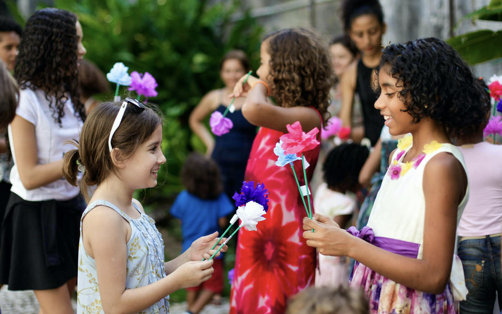
Bahá’ís believe lasting social change begins in neighborhoods and everyday spaces where relationships are built on love and mutual respect. Around the world, small gatherings in homes and community centers bring people of all cultures, religions, ages, and races together to grow through activities like devotionals, study circles, children’s classes, junior youth groups, and youth initiatives. After exploring this page and its resources, visit our Columbia Community Building Activities page to get involved in Columbia.
Service and worship are at the heart of the pattern of community life that Bahá’ís around the world are trying to bring into being. Prayer is integral to Bahá’í life, whether at the level of the individual, the community, or the institutions.
Bahá’ís see the young as the most precious treasure a community can possess. In them are the promise and guarantee of the future. Yet, in order for this promise to be realised, children need to receive spiritual nourishment. In a world where the joy and innocence of childhood can be so easily overwhelmed with the pursuit of materialistic ends, the moral and spiritual education of children assumes vital importance.
Young people falling between the ages of 12 and 15 and representing a transition from childhood to youth, young adolescents—referred to as “junior youth” in the Bahá’í Faith—experience rapid physical, intellectual, and emotional changes. The Junior Youth Spiritual Empowerment Program is a neighborhood program where they can develop the powers of the soul and mind that not only enable them to transcend challenges they are facing but also be active contributors to building a better society.
Developing the Capacity of Youth
Efforts of the Bahá’í community to contribute to the empowerment of young people are guided by an evolving conceptual framework that views youth not as mere recipients of services, but as protagonists of change in their own right — with the capacity to make a vital contribution to the fortunes of humanity. Our understanding of human nature and human purpose is central to our conceptual framework and imbue our actions to promote youth empowerment.
Imagine an ongoing conversation taking place among friends in thousands upon thousands of social spaces—neighborhoods, villages, schools, universities, and workplaces—concerned with contributing to the advancement of civilization through the application of Bahá’u’lláh’s teachings such as consultation, equality of men and women, the elimination of all prejudices and more.
Bahá’í efforts of social action seek to promote the social and material well-being of people of all walks of life, whatever their beliefs or background. Such efforts are motivated by the desire to serve humanity and contribute to constructive social change. Together they represent a growing process of learning concerned with the application of the teachings of Bahá’u’lláh, along with knowledge accumulated in different fields of human endeavour, to social reality.
Participation in the Discourses of Society
Bahá’u’lláh counselled Bahá’ís to “Be anxiously concerned with the needs of the age ye live in, and centre your deliberations on its exigencies and requirements.” As such, Bahá’ís throughout the world—both individually and collectively—strive to become involved in the life of society, working shoulder to shoulder with all people and divers groups to contribute to the advancement of material and spiritual civilization.